Last Updated on January 10, 2025 by
Sanskrit: विष्णु, Viṣṇu
Free Simple Vishnu Puja PDF

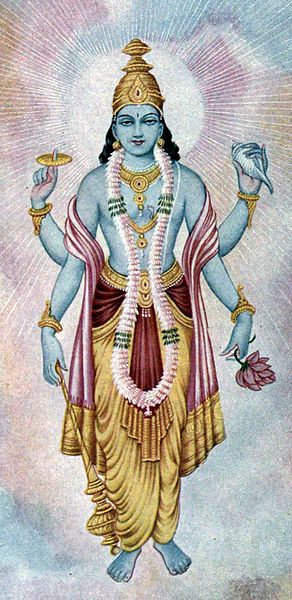
Lord Vishnu is the all-pervading, omnipresent, Supreme Divinity of Creation. Viṣh means the universe, and ṇu means who pervades or embodies. Vishnu is He who pervades the universe, or embodies the universe.
Lord Vishnu, also known as Nārāyaṇa or Hari, is the Preserver and Sustainer of the Hindu trinity (Brahma, Vishnu, and Shiva). Together with His consort, Lakshmi, Vishnu protects the circumstances of all beings in creation.
Vishnu is also the protector of Dharma, or righteousness. In Chapter 4, Verse 7 of the Bhagavad Gita, Vishnu, in the form of Lord Krishna, declares:
yadā yadā hi dharmasya glānirbhavati bhārata
abhutthānamadharmasya tadātmānaṃ sṛjāmyaham
“For whenever the Ideals of Perfection decline, Descendant of the Light of Wisdom (Arjuna), and there is a corresponding increase in selfish conduct, in derogation to the Ideal, then I make myself manifest.”
The Ten Incarnations of Lord Vishnu
Scripture tells us that Vishnu has ten incarnations, called daśāvatāra (das is ten, and avatara is an incarnation of God). Two of his most well-known incarnations are Krishna and Rama, but all of His manifestations have beautiful stories to enlighten the mind and brighten the spirit. These incarnations are:
- Matsya (the fish)
- Kurma (the turtle)
- Varaha (the boar)
- Narasimha (half-lion, half-man)
- Vamana (the dwarf)
- Parashurama (Defender of Dharma with the battle-axe)
- Rama (Lord Rama of the Ramayana)
- Balarama (elder brother of Lord Krishna) or Lord Buddha, depending upon the tradition
- Krishna (eighth son of Devaki and Vasudeva, beloved Lord of the Gopis, who spoke the great words of the Bhagavad Gita to Arjuna on the battlefield of Kurukshetra)
- Kalki (Vishnu’s final incarnation, who, it is said, will appear at the end of the Kali Yuga)
Worship and its Benefits
While stories tell the glories of Vishnu’s specific manifestations, Vishnu as the eternal and all-pervasive Consciousness of Creation, is everywhere at all times. There is nowhere He is not, and that is why we worship Him.
We worship Vishnu by paying attention. We focus our attention to the exclusion of the wandering mind, and therefore attain to efficiency in our every thought and action. In doing so, we become aware of Vishnu’s presence in all of our daily activities, and every activity becomes a form of worship.
What is Vishnu Puja?
One type of spiritual discipline is called pūjā. Pū means merit, and jā means birth. Pūjā is the activity which gives birth to the highest merit: the privilege to sit in the presence of God.
On one level, pūjā is a form of worship performed at the altar. It is a guided meditation in which we offer devotion to our chosen deity with Sanskrit mantras, flowers, milk, yogurt, ghee, honey, sugar, water, and other offerings.
However, pūjā is not something that is only performed in the temple. To be true worship, it must pertain to all life. It is an attitude of respect that we carry with us at all times.
Ultimately, our pūjā is the attainment of complete absorption, complete surrender, and complete efficiency in every action that we perform for God. Because Vishnu lives everywhere and in everything, there is no action that we can perform that is not for God, in one form or another. That remembrance of that is our pūjā.
So we start by worshiping Vishnu at the altar – we chant His mantras, perform His puja, and sing the Vishnu Sahasranam (the One Thousand Names of Vishnu). We then gradually come into the awareness that every name for everything is but another name for Vishnu.
Om Klīṃ Viṣṇave Namaḥ! – Om we bow to the Cause of Merging the physical manifestation in to Intuitive Perception of He who Pervades the Universe!
Worship and Celebrations at the Devi Mandir
At the Devi Mandir, God is worshiped every day in so many forms. Vishnu’s worship is performed daily as part of the Cosmic Pūjā.
On every full moon day (purnima), we also chant the Viṣṇu Sahasranāma and Satya Nārāyaṇa Vrat. The Satya Narayana Vrat Katha is the Story of the Vow to Speak and Act in Truth.
After chanting the Vrat Katha (story), all devotees take part in special prasad known as Sapad Baksh, the recipe of which is given in the Satya Narayana Vrat by Lord Narayana Himself. Please click here for the Sapad Baksh Prasad Recipe.
Reference Material
Viṣṇu Pūjā (Includes the Viṣṇu Sahasranāma, and Satya Nārāyaṇa Vrat) by Swami Satyananda Saraswati. This is also available as an iPad App.
Satya Nārāyaṇa Vrat video classes by Swami Satyananda Saraswati and Shree Maa.
Bhagavad Gītā by Swami Satyananda Saraswati. This is also available as an iPad App.
Sundar Kāṇḍa by Swami Satyananda Saraswati. This is also available as an iPad App.
Viṣṇu Sahasranāma sung by Shree Maa.