Day 1 of Navaratri
Early Morning: Puja
I woke up at 5 am, had a cold shower (a good way to stimulate the release of endorphins), dressed in clean clothes, and opened the temple.
I bowed down to Ghoti Maheshwar, then walked around the perimeter, offering a quick “Namaste and Good Morning” to each deity. If you haven’t visited the temple before, this video will help you get a better sense of the layout.
The previous evening, or rather late at night, Shree Maa had called me briefly and asked me to offer Cosmic Puja at the Durga altar. I had performed the puja only once, in its entirety, at the Devi Mandir in Napa several years ago, and wasn’t at all sure of the precise flower positions that Swamiji had envisioned, almost as though extending the yantra in different directions. And then there was the question of the yantra — I didn’t have one. How was I to make up for this deficit in the puja? What could I do?
Improvising My First Cosmic Puja
I panicked, seriously considered calling up some of the satsang brothers and sisters who were more experienced in this puja, and requesting a crash tutorial. Had it not been so late at night, I might even have gone ahead with that idea. Instead, I calmed down and thought about all that I *could* do. I could recite the mantras cover to cover. I could draw the yantra on paper and place it on a plate. I could offer flowers and arrange them in the prettiest possible formation. In short, I would do the best I could and improvise until I had more knowledge and information. Feeling more cheerful, I entered the temple with a plan of action.
The next couple of hours were spent getting everything ready. Since everything was still new and unfamiliar, I took a long time preparing the ingredients for the puja — hunting down offerings of milk, yogurt, etc., along with the dhoop, deep, phalam, and pushpam. At some point that morning, Moushi walked in and helped me find some of the more difficult-to-locate items.
And then there was the question of flowers. In a proper Cosmic Puja, around 150 flowers are offered (approximately, of course). Usually, these are of three different colors or varieties, along with a few large or special flowers for specific purposes such as sankalpa, pran pratishta, etc. While the fridge was stocked with yellow and orange marigolds and white chrysanthemums, I cringed at the thought of cornering the flower supply as a recently arrived pujari. Besides, every item had to be transported from Nashik, so everything needed to be used carefully. I therefore resolved to do the puja with petals instead.
As for the yantra, I had practised drawing it on paper the previous night, recalling the instructions from Swamiji’s class. Using a bottle cap to draw the circle and a folded piece of paper as a straight edge, I had managed to produce a passable yantra on paper. However, I decided to keep things simple and perform the puja without the yantra the first day.
By around 7 am, I was finally ready to begin the Cosmic Puja and do it in my own style. (Sorry, Swamiji! I will get better in the coming days, but I have to start somewhere!)
I sat in front of the altar and began the puja. As promised to myself, I went through all the mantras cover to cover. Since Swamiji had already established a pot in front of the deity, I simply chanted the mantras without actually establishing another one. Similarly, I wasn’t keen on performing Jal Neti using just the water held in the palm of one’s hand, so I skipped that section.
I arranged a combination of petals and flowers into a reasonably attractive puja offering, and slowly began to see a pattern emerging that I could use for future pujas — the 11 flowers in one formation, the 9 flowers in another, and the 16 in yet another. I could already see how I might position them more creatively the next time.
By around 10 am, I had completed the puja, tired but satisfied that I had given it my best. It was nothing like the completed Cosmic Puja layout, but there it was—a mix of petals and flowers, offered as best I knew how.
Maa Comes to the Rescue
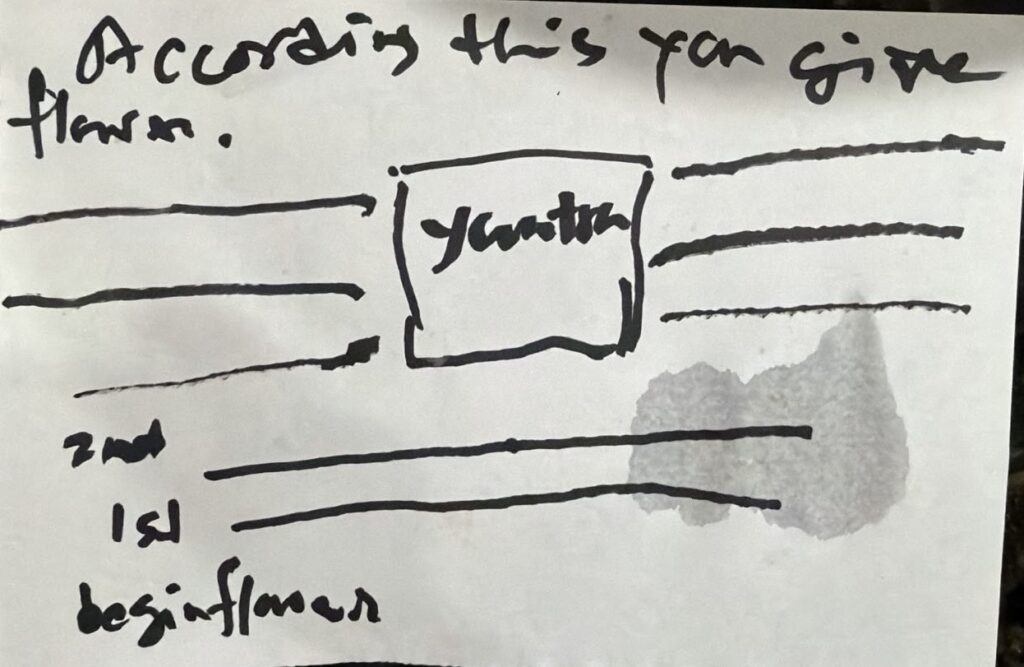
Almost on cue, Maa called me. When She heard about my petal-positioning antics and the absence of a yantra, She told me how She performed the Cosmic Puja every day. She instructed me to arrange the flowers in neat rows around the yantra, starting at the bottom and working my way up towards the pot and deity. Since I wouldn’t be performing the puja again until the day after, I had plenty of time to digest all this information and attempt a better flower layout next time. She even drew the instructions on paper and had them sent to me for reference.
After a quick cleanup, I had a breakfast of steamed moong beans, which Brahmani Maa had had the foresight to request the previous night. An easily digestible food, with a great protein boost to start the day, yet light on the stomach — something that would prove important, as we had to get ready for our Chandi Homa at 10:30 am.
Mid-Morning: Homa
As with the puja, we had to hustle to get the havan kund set up, with help from Moushi and Prashant. Did we have all the offerings? Enough firewood? Were we missing anything? It turned out that we were always missing something in those early days, but we got better as time went on. In fact, I now have a mental checklist for both Cosmic Puja and Chandi Homa that I need to put down on paper and share with those interested.
Antarma and Shila had arrived at the ashram by then and joyfully joined the homa. We took the sankalpa that would be repeated for the first eight days, until Mahashtami — for the good health and longevity of our beloved Shree Maa and Swamiji, and for the welfare of all three worlds. We would offer ahutis of the Tantra Bijamantratmaka Chandi, with “Om Hrim Chandikayai Swaha” as the samput. Our ninth day (Navami) sankalpa was a little different, and more on that later.
Brahmani Maa led us in invoking the fire. After a round each of “Om Gam Ganapataye Swaha,” the Navarna mantra, and “Om Namah Shivaya Swaha,” we proceeded with the Tantra Bija Ratri Suktam, followed by the thirteen chapters of Tantra Bija Chandi. We then offered thanks to the invoked deities through the Sarvato Bhadramandala Devata Homa, followed by purnahuti with a coconut.
This completed our homa sankalpa for the day. Leaving Antarma and Shila to continue with their own additional homa, we went to lunch, followed by laundry and some well-deserved rest. See below for a clip from homa on one of the days of Navaratri.
Evening: Aarti, Parikrama, Bhajans and Planning
Everyone, including the caretakers Moushi and Mama, gathered for Aarti at 6:30 pm. With the clanging of bells and the beating of drums (Antarma was on the drums), we offered incense, five lights, camphor, viseshargya, dhuni (frankincense), an umbrella, cloth, chamar, a fan, a mirror, and flowers to the deities.
We did parikrama (circumambulation) around the temple three times, waving the same items towards the spire, the waxing moon, the eight compass points (N, S, E, W, NE, NW, SE, SW) around the temple, each of the three doors, and the external Nandi altar. Everyone chanted “Jai Maa” in cadence; some danced, while others followed more sedately. After three rounds of parikrama, we went back inside and completed the Aarti. See below a clip of the evening parikrama, taken on Mahastami day.
Prashant Baba said that Maa had requested us to chant the mantra of each deity in the temple eleven times. He then led us in japa, following the order of the deities we would encounter if we entered through the south door and circumambulated the temple clockwise.
Om Gam Ganapataye Namah
Om Ham Hanumate Namah
Om Klim Kalyai Namah
Om Shrim Lakshmyai Namah
Om Sam Saraswatyai Namah
Om Namah Shivaya
Om Krim Krishnayai Namah
Om Hrim Radhe Namah
Om Dham Dhanvantaryai Namah
Om Ram Ramaya Namah
Om Hrim Sitayai Namah
Om Hrim Annapurne Namah
Digambara Digambara Shri Paada Vallabh Digambara (chanted to a very catchy tune that made us all wish it were a longer kirtan!)
Om Shree Gurave Namah
Om Llim Bagalamukhyai Namah
Om Hrim Shrim Dum Durgayai Namah
Om Aim Hrim Klim Chamundayai Vicce
We followed the above japa with the Siddha Kunjika Stotram, mainly because we hadn’t offered it during the homa that morning. Then it was open-mic night, with bhajans! I sang “Anandamayi Anandashakti,” and Brahmani Maa followed up with an original song dedicated to Shree Maa and the Divine Mother, based on a popular Krishna bhajan. Antarma drummed along, while Prashant shook the wooden manjira (a wooden instrument with multiple metal cymbals), giving the whole atmosphere a festive mood.
I felt that we were all, in our own ways, trying to add to the Navaratri bhava and compensate for the absence of our beloved Shree Maa and Swamiji. We missed them so much that we did everything we would have done had they been leading our homa and Aarti sessions, almost willing them to be there. In doing so, in trying so hard, I felt their presence — and I am sure others felt the same way. It was soothing.
We said the closing prayers. I offered the conch water to everyone assembled, Brahmani Maa applied the tilak, and someone else distributed the prasad. We agreed on the schedule for the next day, becoming a little more efficient with each passing day: Brahmani Maa would do the Cosmic Puja, I would do the Shiva Puja to Ghoti Maheshwar, and Antarma would lead the homa.
Night: Dinner and Clean Up
Next came a fantastic dinner, courtesy of Prashant. Although he had help from two ladies who joined us on the first day and stayed for the entire nine or ten days, he was the chief cook, menu planner, and organizer.
Mindful of Maa’s instructions, he not only served what She had suggested — Kitchuri and Labra — but also added a variety of other dishes each day, giving each his own unique twist. I am trying to recollect all the different dishes: varan, kadhi, thecchaa (my favourite!), rice, jowar chapati, wheat chapati, vegetables cooked in interesting ways, innovative desserts such as sapota halwa made from scratch, and dishes such as pav bhaji. Once, he even made dosa and idli to ensure that I didn’t miss South Indian food. So kind and thoughtful!
He also fed everyone on the premises, including the daily workers, before having his own meal. I meet some of the best people through their connection with Maa, and their love for Her is almost sweeter than Maa Herself.
After dinner, we went back to the temple to perform visarjan for our pujas, clean the altars, purify any flowers that could be reused, set up our plates with offerings for the next day (getting better all the time!), and take care of the many other things that needed to be done so that all that remained was to sit in asan. At least, that was the ideal we were working towards!
After cleaning up, we closed the temple, satisfied that we had established a good, sustainable rhythm of worship. It wasn’t perfect because, even though Maa called and checked in on each of us multiple times during the day, we were still operating independently and sometimes at cross-purposes with one another.
We would improve over the next few days, agreeing on the steps for the homa, fine-tuning the Aarti process, learning where to find puja items and where to put them back, cleaning the temple together each evening, and switching off the lights and fans so that we could reset everything for the next day.
(To be continued…)