Last Updated on October 27, 2026 by Nanda Maa
Days 2-8 of Navaratri
Settling into a Rhythm
The days began to follow a predictable rhythm — 5 am wake-up, bath, Cosmic Puja (although I did Shiva Puja on Days 2 and 5), breakfast, homa at 10:30 am, lunch, laundry, rest, walk, Aarti, dinner, cleaning the altar and preparing for the next day, and finally, sleep.
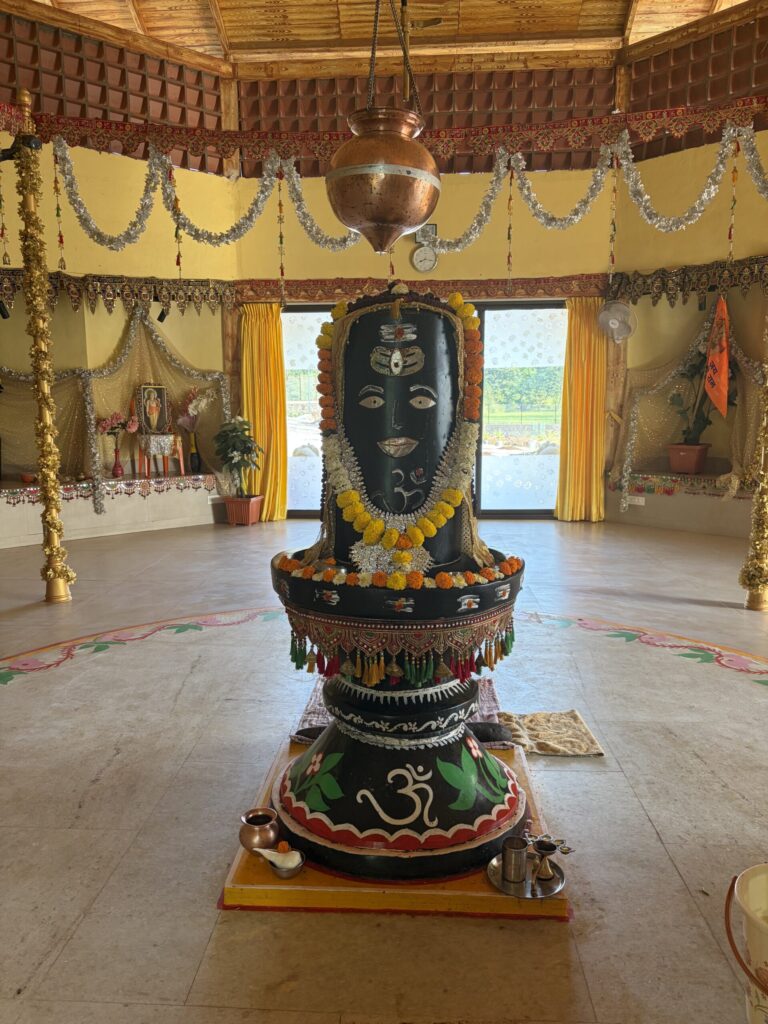
On the second day of Navaratri, Brahmani Maa offered the Cosmic Puja, so I got a chance to offer Shiva Puja to Ghoti Maheshwara.
A Special Love for Shiva Puja
A Shiva Puja is somehow more engaging, more absorbing than any other puja I have done. It may be because we actually bathe the idol with milk, yogurt, ghee, honey, sugar and panchamrit, followed by water. It is almost like washing a baby — I can’t get distracted!
And I get to see the results of all that pampering — the idol looks clean, fresh and alive after the bathing, dressing and decorating. When I offer food and water to Shiva after bathing and decorating him, it really feels as though I am making the offerings to a living, breathing entity. Given a choice, I’d pick Shiva Puja any day, with a puja to Baby Krishna coming a close second.
It was interesting to see how each person decorated the Shiva lingam. Some people even drew a mustache on Shiva, while I liked mine clean-shaven!
Getting the Cosmic Puja into Shape
On the third day, I performed the Cosmic Puja, and this time I was a bit more prepared, thanks to Maa’s coaching. I also mentioned to Prashant Baba that we would need lots of flowers for the puja. He was supportive and promised to order more as needed.
I also had a plan for the yantra. I remembered Swamiji telling us that we could draw it on any plate using a matchstick and sandalwood paste. So I found a suitably sized stainless steel plate in the supplies area and drew a decent yantra, using a small cup to make the circle and a steady hand for the rest.
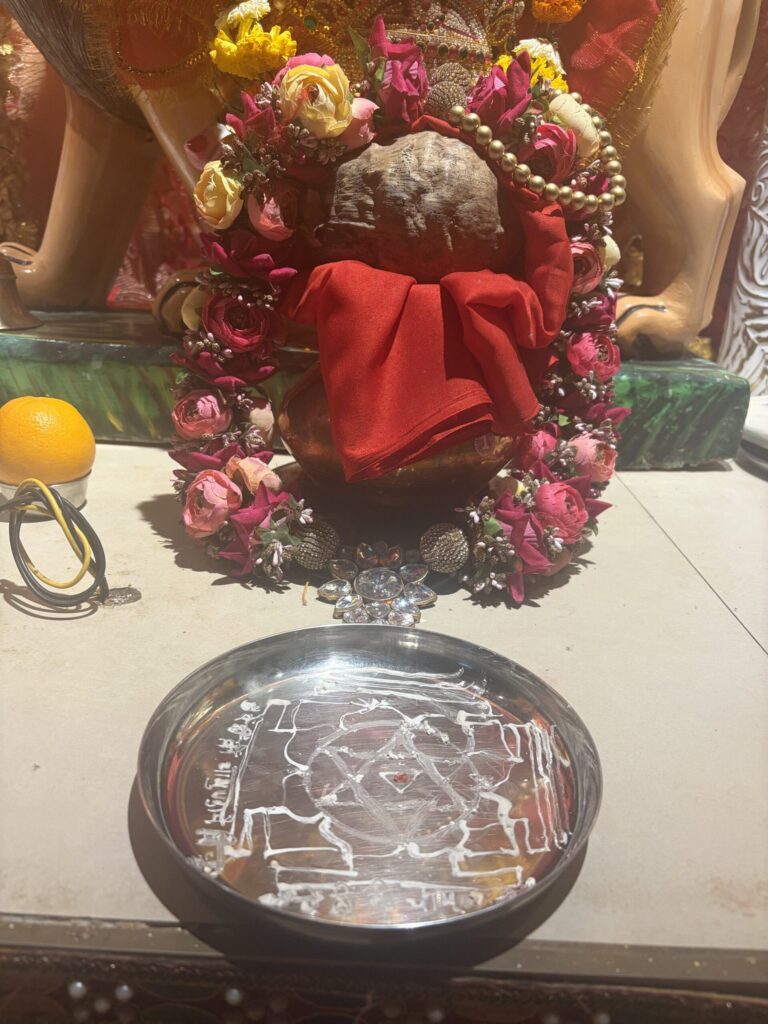
I did most of the mantras in the Cosmic Puja, leaving out only the establishment of the pot and the associated mantras, as well as the jal neti.
I also worked out a flower arrangement that was as symmetrical as I could make it. I pored over the Cosmic Puja “map” that comes with the book, but had to make allowances for the narrow area in front of the pot. I couldn’t move the pot, since Swamiji had established it, and I had to work with the space available. As my yantra was positioned right at the edge of the altar, I used the original flower layout more as a guideline than a set of exact positions.
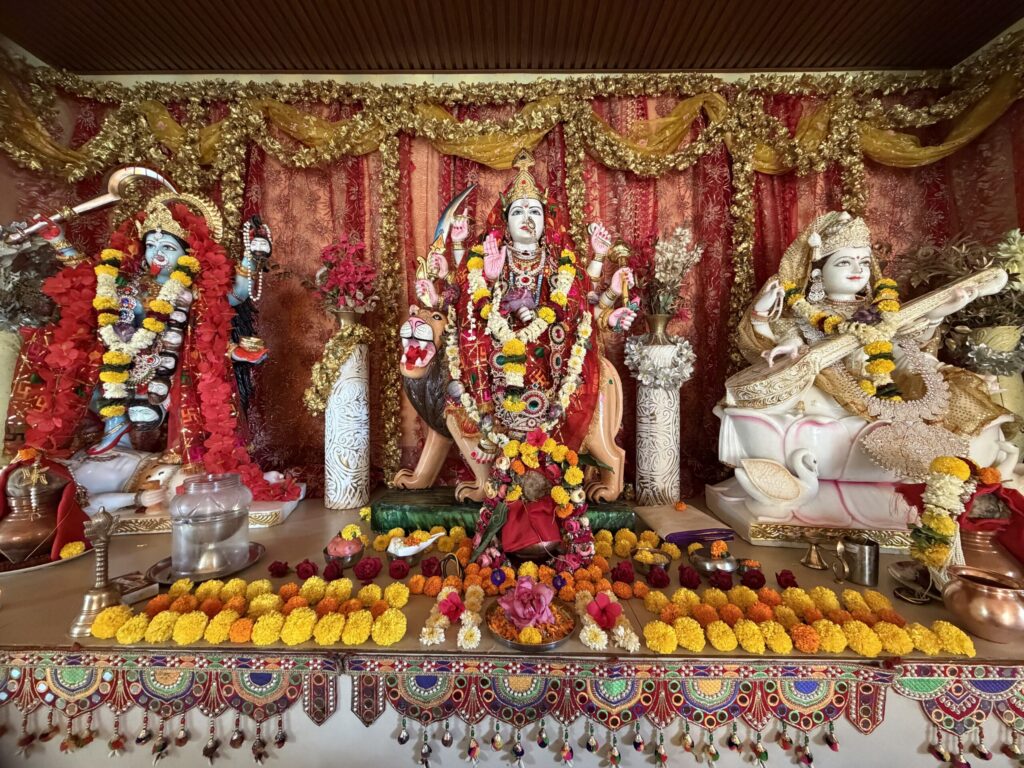
The Cosmic Puja began to look decidedly better and continued to improve over the next few days as I gained confidence through practice.
Homa: A Community Effort
While the pujas were mostly solitary activities, Shiva Puja became a shared love for both Brahmani and Nayna. The homa, on the other hand, was a group effort. It was also the main event, apart from the evening Aarti, where visitors from outside the ashram joined us.
On some days, it was just four or five of us chanting as one and feeding the divine fire. On other days, more people joined us — friends and acquaintances from Nashik, people from the extended neighborhood, Moushi and the ladies from the kitchen, or relatives who popped in for the day.
As expected, the biggest turnout was on Ashtami, with some people taking the sankalpa along with us and making their offerings to the fire with great sincerity. I noticed that everyone who joined us for the homa, whether they were smart city-dwellers or people from the local village community, made their offerings attentively, even though they didn’t have the mantras or the books with them. They sat patiently for as long as it took — usually between 90 minutes and two hours. Kudos and pranams to these attendees for their dedication and sincerity!
It has almost become a tradition for Shree Maa to offer lotuses into the fire on Mahashtami. This Navaratri, too, the lotuses were offered into the fire, strengthening my feeling that even though Maa and Swamiji weren’t physically present at the ashram, we could feel their presence in each and every detail we added.
Kumari Puja: The Grand Plan
The highlight of Mahashtami was, of course, the Kumari Puja in the evening. It also turned out to be a lesson in letting go of control.
A few evenings earlier, after Aarti, we had all got together to discuss the logistics and planning for the Kumari Puja. The plan was to worship three Kumaris, the children of Prashant’s friends.
I was to discuss the puja paddhoti with Swamiji and get his approval, and read the mantras aloud during the actual puja. Brahmani, Antarma and Shila would perform the necessary rituals (bathing, feeding, etc.). Prashant was to act as the go-between, fetching anything the pujaris needed that they couldn’t reach themselves.
That was the plan! God was laughing somewhere.
The previous day, having got clear answers from Swamiji to my questions about the puja and made a mental note of everything we needed, I conducted a walk-through with the pujaris so they knew what to expect and when — sort of like a puja rehearsal. Brahmani, Nayna and I also checked the clothes, jewelry, chocolates and sweets we were going to present to the little Goddesses. I also caught up with Prashant and asked for three sets of plates deep enough to perform the pada puja. Moushi showed me several options, but we finally settled on three identical plastic bowls that would do the job, along with new towels to dry the little girls’ feet after the puja.
We were almost ready! All that remained was to prepare the perishable items the next day and have everything ready at hand.
When the Plan Went Out the Window!
Come Mahashtami, and the homa, which was supposed to start at 10:30 am, got delayed by almost an hour as we waited for a couple of guests who were going to take the sankalpa with us. Naturally, the finish time was pushed back by an hour as well. With so many people attending, lunch and all the feeding arrangements were completed only around 3 pm.
We were supposed to rest for “a few minutes” and then regroup to get the puja plates ready and dress the Kumaris, who were expected around 3:30 pm, so that we could start the puja at 4:30 pm.
The “few minutes” stretched into nearly an hour, as everyone was exhausted after a particularly intense homa. I couldn’t rest, so I went into the temple to start preparing the three sets of plates for the bathing offerings (milk, yogurt, etc.) and the food offerings (fruit, sweets, chocolates) — one set for each pujari. I also hunted for lamps, incense holders and matchboxes, which seemed to disappear just when I needed them most.
Shila, Moushi and Antarma drifted into the temple and started helping me. We set up the altars and the pujaris’ seats, positioned all the required items within each pujari’s reach, and thought we were ready.
Then Prashant mentioned that there were going to be five Kumaris for us to worship, not three as we’d thought.
I shrieked! We were barely ready for three, and now we had to scramble to put together more plates and everything else for two more?!! Did we even have enough utensils to perform the puja?
Prashant said that we couldn’t possibly disappoint the families of the two little girls, so we’d just have to manage as best we could.
I realized then that, despite all the painstaking planning, communication, rehearsals, etc., we’re never really prepared for what actually happens. Sometimes, we just have to go with the flow.
So that’s what I did. Magically, Moushi procured two more bowls for the puja. One of the devotees was roped in as an extra pujari, while Brahmani took on double duty and worshipped two little Goddesses simultaneously. Three more asans were added — for the two girls and the extra pujari. The plates of bathing and food offerings were shared, and people took turns offering lamps, incense, etc.
It wasn’t the perfectly organized puja I’d envisioned, but it passed muster.
The little girls looked adorable, and each had a different personality. The oldest, a ten-year-old, looked calm and self-assured, while the youngest, a tiny two- or three-year-old, looked sweetly dazed. There was also a placid child who looked intently at everyone, diligently did as she was told, and placed her hand over our heads to offer blessings when asked. Another was restless and squirmy and clearly longed to get back into her more comfortable clothes. The fifth child enjoyed all the attention she was getting and smiled happily at us.
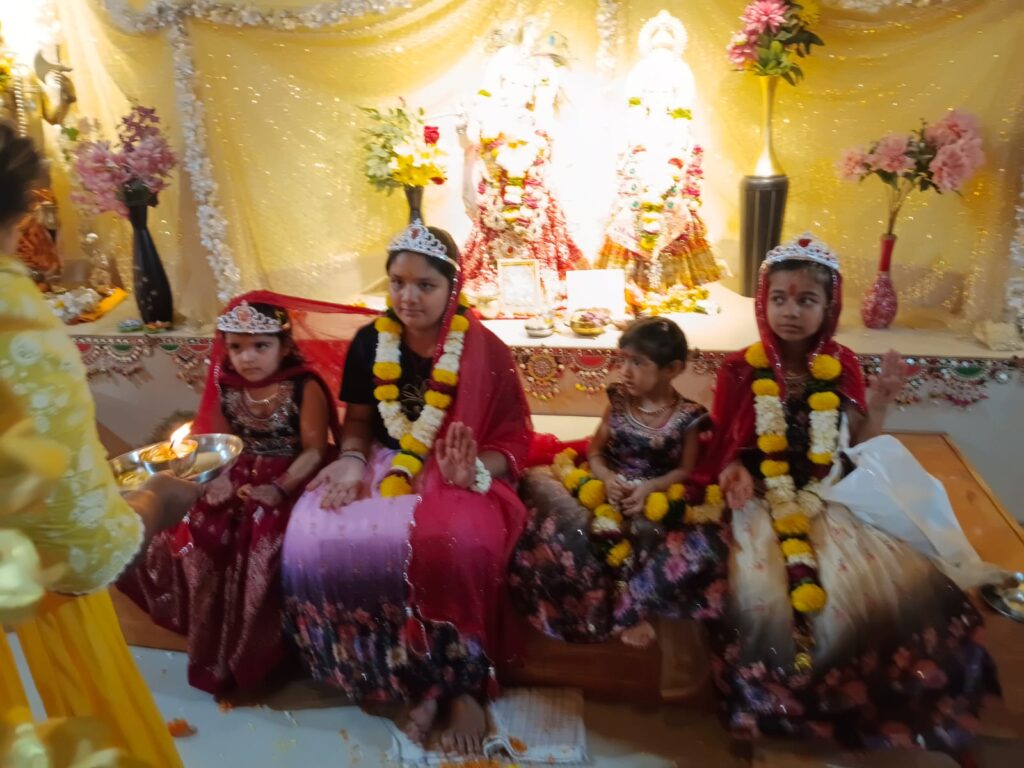
We offered dakshina and Aarti to the little Goddesses and performed the temple parikrama — a fitting finale to the Kumari Puja.
(To be continued…)