• Home
    • What’s New
  • About Us
    • Shree Maa
    • Swami Satyananda Saraswati
    • Mission and Goals
    • Who We Are
    • Our Inspiration
    • Testimonials
      • Books
      • Magazines
      • Newspapers
      • TV Appearances
      • Testimonials
    • FAQs
    • Contact Us
  • Support
  • Worship
    • Classes
      • Audio Classes
      • Video Classes
      • Presentations
    • Worship
      • Gods
      • Goddesses
      • Gurus
      • Sankalpas
      • Mantras
    • Cooking
    • Yoga
    • Philosophy
    • Astrology
    • Spiritual Business
    • Spiritual Blogs
      • Travelogues
      • Stories and Articles
      • Relationships
      • Poetry
  • Spiritual Life
    • Presentations
      • Cosmic Puja
      • Dasnami Sannyasins
      • Das Mahavidyas
      • Family Wealth
      • Generals of the Chandi
      • Jyotirlingams Mantra
      • Kashyap Sutras
      • Nine Steps of Devotion
      • Panchang Tutorial
      • Tattva Jnana
      • Mudras for Puja
      • Sadhana Panchakam
      • The Yamas in Devi Gita
    • Sanskrit
    • Spiritual Business
    • Faqs & Video Excerpts
      • Deities
      • General Philosophy
      • Scriptures
      • Worship and Practices
  • Connect
    • Instagram
    • Facebook
    • YouTube
    • WhatsApp
    • Telegram
    • Zoom
    • Contact Us
  • Locations
    • Ashrams
      • USA
      • India
      • Costa Rica
  • Downloads
    • Free English Books
    • Free Hindi Books
    • Free Bengali Books
    • Free Books in Other Languages
  • Store
    • Books
    • Apps
    • Audio

Devi Mandir

Temple of Divine Mother

  • What’s New
  • देवी मंदिर हिंदी में
  • Podcasts
    • Commentaries
    • Sound Cloud Podcast
    • YouTube Podcast
    • Spotify
    • Chanting
    • Singing
  • Social Media
    • Facebook
    • Telegram
    • Whatsapp India
    • Instagram
  • Online Satsangha
    • zoom
    • You Tube
  • India
    • Nashik
    • Kamakhya Navaratris
    • India Yatras & Special Puja
  • USA
  • Costa Rica & Peru

Chandi Class Notes: Chapter 10

In Chapter 10 Goddess is fighting Self-Conceit on behalf of the Gods.

Q&A

1. What is the difference between Mahishasura from the second episode and Self-conceit in the third episode?

Mahisasura is the Great Ruler of Duality, of all dualities. He is the controller of the 6 ripus (limitations): desire, anger, greed, ignorance, avarice, and jealousy.
Self-conceit says, “Boy, did I do a good job. Look at my success. Even I admire me. I am sure everyone else does.”
Self-deprecation says, “Poor me. I blew it again. I am not good enough.”
They are similar. All three episodes are going on concurrently. It is not a linear progression. It all happens at once. All the asuras are acting simultaneously. What can we do? We can cry, “Maa please help us.”

2. What is the significance of the half-moon on the Goddess’ head in the Dhyanam of this chapter?

The moon is the emblem of devotion. The Goddess wears devotion as an ornament.

3. Does Swamiji recommend that we introspect on our negative thoughts in addition to chanting the Chandi to cut down asuras?

No. Instead of dwelling on negative thoughts, dwell on presence of Mother – “She is within me, She is in my heart.”
Dwelling on negative thoughts increases the strength of self-conceit and self-deprecation. Fill yourself with full, pure, loving, positive, joyous devotion.

4. If the goal of sadhana is to transcend the ego, how do we understand the ego’s desire to chant the Chandi?

God within us is inspiring ego to become Divine Ego. Purpose is not to destroy ego but to expand the ego become the greatest egoist. I am Shiva. Aham Brahmasmi. No negative small ego left.

5. Sumbha wanted to fight only one Mother and not her manifestations. What is the significance of this?

He was conceited that he thought that if She withdrew Her manifestations, he would be able to defeat her.

6. Can you please talk more about Verse 8?

When there is manifested existence, everywhere we look we see a different form. When Mother withdraws forms we are moving to non-duality, there is only Self-conceit and Mother: savikalpa Samadhi. Now, he is trying overcome and bring her to duality. She is saying, “no, you have to leave your self-conceit and see all the energy of the Universe within me: Nirvikalpa Samadhi.

7. What is the significance of the self-conceit bringing his fist down on Devi’s heart?

Heart is love center. He is striking at the devotion of the devotees, disrupting the love in Her heart.

8. In Chapter 8, Maa is the Shakti of Shiva and Shiva resides in the sahsrarara, what is the significance of Shiva being sent as messenger of Mother>

Consciousness is going to self-conceit and gives an order. Consciousness comes down from Sahsrarara and illuminates the chakras.

9. What is the significance of the Goddess striking self-conceit with the palm of Her hand?

He struck Her with her fist, She just gently strikes him with a palm. That’s enough to knock him down.

10. Maa Kali cuts off the heads of Her devotees during their sadhana. How does one visualize the ishta when one has no head?

It takes a lot of prayer to lose your head. And once you lose your head, no prayer is required, until it grows back.

11. Is there a correlation between the Goddesses that we meditate in each chapter and the negative forces She vanquishes in each chapter?

Yes. In this chapter when you have surrendered to Kameswari, you have only one desire left, to be with Her. If you contemplate her form, you will lose all your self-conceit, you have no more desires.

12. If Mother wants us to take us Samadhi, why do we hold on to worldly objects?

Ego rebels, when we say we going to kill it. There is a sense within that if I don’t survive how can I enjoy Samadhi? It wants to enjoy Samadhi and be there and then come back and tell everyone about it. And so I can tell everyone about it. Ego is devious when he comes out.

13. If we go back to original desire, will Devi destroy that too?

When we enter into the one desire to be with Mother, we lose all other desires. That is pralaya, dissolution of manifested existence. Then there is another creation. If we are fortunate we remember what it is like to be in samadhi and we quickly learn how we can unite with God and what good karmas I can do to inspire others to attain the same.

14. In verse 8, Chapter 4, Divine Mother is Svaha. Why do Gods become content upon hearing the word?

Svaha is the wife of Agni. When we make an offering, Svaha takes it away from Agni and gives it to Gods. So Gods become contented.

15. In Chapter 1, can the forest also be seen as symbolic of consciousness mind?

Yes. Absolutely. We are moving to forest of purity, tapasya, and non-attachment where we can contemplate purity and clarity and how we can unite with God without selfish desire.

16. When Mother fights self-conceit, why did all Gods just look on without participating?

They knew that only Mother can slay self-conceit. We (the Gods) become witness of Mother slaying self-conceit.

17. In Chapter 8, there were many energies of Goddess that could not defeat Raktabija. Why?

They could not because the seed of desire had won the boon that each time a drop of blood fell from his desire a new desire would be created. All energies wounded him and his blood poured profusely. And there was a new desire. Only Mother Kali could drink up all the blood.

18. Is it better to pray to Mother to take away desire than to pray to fulfill it?

Better to pray to be with Divine Mother. Then all the other desires go away of its own accord. They pale in significance to the desire for Mother. That’s why chanting the Chandi is such an important tool because singing the Chandi is a desire to be with You.

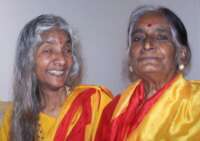
Shree Maa and Bara Maa

~~OM~~


Photo of the week – May 17 – May 23, 2008
(Picture taken April 2008 at Devi Mandir, Napa, CA)

Shree Maa and Her Mother!

Chandi Class Notes: Chapter 9

~~OM~~

In the meditation, She is the supremely divided one, who is both male and female continuously without end. S(he) is Ardha-nariswara or Ardha-nari-iswari.

In verse 11, Self-deprecation strikes the Lion, Dharma on its head. This means, every time we say, “I can’t”, “I’m not good enough”, Dharma is injured.

Q&A
1. The mind is very quick. We get a thought and then we can only observe that we that have had a thought. How does sadhana help us be a witness to the thoughts?

Sadhana is to call Mother to take the thought away. Focus on Mother to take the thought away. We are the observer of the thought in relationship to the Mother. That’s the sadhana.

2. Before we are attacked by self-deprecation or during self-deprecation, is the only thing to do to call on Divine Mother?

Yes. Take away my inefficiency. We are saying the words, at least. Make us feel the words. Give us devotion that causes us to focus our attention on you. So that we can perform with optimum efficiency, without self-deprecation or self-conceit, paying attention to You.

Ask for Suddha Pavitra Chirastay Vyakulat Ananya Bhakti – pure, purer, infinite, sincere, infinite Bhakti.

3. Could you tell us the difference between modesty and self-deprecation?

Modesty means, “I don’t want to blow my trumpet. I will try to be humble.”
Self-deprecation is the thought, ‘I am not good enough, my behavior is inadequate, etc.”

4. What does confidence mean?

I know my devotion is sincere. I am going to serve you with greatest sincerity possible.

5. If we make a mistake, what should we do?

First you say, “I appreciate the correction.” Then ask, ‘How do I do it correctly?” Learn from your mistake. Don’t focus on self-deprecation. Pay attention, absorb like a sponge. If you can, write down the answer. Then read it. Then read it again, later. One day you might share this lesson with others.

6. Why do we battle the Lord of Confusion (verse 30) and het worship Mother in the form of confusion in Chapter 5?

In Chapter 9, we say, “I don’t see You (Mother), and that’s why I am fighting the Lord of Confusion. Once self-conceit is defeated and we get out of confusion, I see that everything is You (Mother) in the form of confusion.

7. The asuric qualities described in the Chandi pertain to the conscious mind. How do we defeat the asuric qualities that are unmanifest in the unconscious mind?

We are still working with the conscious mind. Can I speak about the unconscious? No. I am not aware of them. We can only speak of what we are aware of.

There is samskar, an intrinsic nature which follows us from birth. We become aware of it over the course of our lives.

8. Self-deprecation’s shield is inlaid with eight moons. What is the significance of the moons?

Moon symbolizes devotion. We have a lot of devotion to self-deprecation. We become absorbed in self-deprecation even when people come to cheer us up.

9. How to become more aware?

Chant the mantra. Pray to Mother to give more sincerity, capacity, and devotion. How can I do your work in a way that pleases you?

Is Doing Good Works Selfish or Pure?

~~OM~~

Story of How Ganesha’s Tusk Was Cut (2 versions)

~~OM~~ Parasuram was one of the avatars of Vishnu. He went to see Shiva and Ganesh was at the door. So Parasuram began to fight with Ganesh. Parasuram had received […]

Story of the Churning of the Milk Ocean

~~OM~~ Now remember when we were gonna churn the milk ocean. The Gods and the Demons got on each side, and they were using Mount Mandara as the churning rod. […]

Story of Vishnu and Brahma’s Competition

~~OM~~ One day Brahma and Vishnu were walking down the path. They came to a place where they met, and Brahma was walking from one direction and Vishnu from the […]

The Woodcutter and the Sannyasi

~~OM~~ >Double Click the Video to Play< Remember the woodcutter who met the sannyasi, who said, “Go forward!” And he went past the grove of trees where he was cutting […]

Chandi Class Notes: Chapter 8

~~OM~~

In Chapter 8, we meet Raktabija, the seed of desire and watch how She slays him.

Rakta means passion, blood, red, desire; bija is seed.

Q&A:

1. What is the significance of the energies adorning the same dresses and features of their male counterparts?

Consciousness is masculine and enery feminine. She acts and looks just as he.

2. Does Raktabija represent both fulfilled and unfulfilled desires?

Only unfulfilled desires.

3. If we have no desires, we would lose the zest for life. Does this chapter suggest that the sadhana will lead to a desireless state?

All desires are not done away with. Desire is inherent in creation. Only selfish desires are taken away by the Goddess. Then we are left only with selfless desires. You still will have the desire to eat, sleep.

4. Is the desire to pronounce better, sit longer in asan, etc. forms of raktabija?

These are Raktabija in a positive form. By pursuing these, we take away our negative desires. As we spend less and less time with the positive, we spend more time in negative.

5. Is blood symbolic or the gross substance that courses through our veins?

It is symbolic and symbolizes the negative passionate desire that draws us into worldliness.

6. What is the significance of water (that Brahmani sprinkles on the thoughts) and how can we use it in our daily lives?

Taking a bath is our first act of purification. When we do achaman in puja (sipping water) we purify our lips.

Water symbolizes equilbrium. It is always at the same level, always seeks its own level.

7. What is benefit of recording our spiritual experiences in a journal?

The only benefit is some years later I can read my journal and say that I do not need these journals any more. Objective is to know the experiencer. Remember the intensity of the experience and not the manifestation of the experience.

8. How do we offer desires to Mother?

Increase time spent with the Guru. Also think how would your Guru respond to a certain situation (where the desire arises).
This would be like in engaging in satsang throughout the day.

9. We have a strong desire to chant the Chandi. But then we have to do karma in the world and that prevents us from chanting. How can we overcome this?

You can say to Mother I love you and so I am going to demonstrate my love by doing karma. Then read whatever you can.

10. Surath and Samadhi abandoned their families and kingdom. This was not their highest ideal. Was it?

Both were driven from their kingdom and families. They had no choice. What they did subsequently was certainly their highest ideal because we remember them even today so many years later.

Also, when they left their family kingdom they had good thoughts about their families and kingdom.

11. What questions to ask or not ask our Guru. How do we decide?

Love them with all your heart. Ask the right question at the right time. Do not interrupt Her when She is talking. Be natural, be free.

Chandi Class Notes: Chapter 7

~~OM~~

The protaganists on the side of asuras in Chapter 7 are Chanda and Munda, anger and passion.

Chamunda is the slayer of anger and passion. Cha is to move (from chara), Munda is head or all that is knowable or paradigm of reality. She who moves in the paradigm of reality.

Q&A

1. Spiritual experiences are signposts in our journey to God. Yet we do not undertake sadhana to achieve them. How do we reconcile these two positions?

Spiritual experiences are at best mild distractions. We should not get caught up in them. They prejudice the meditator. Talking about them diminishes their value. The goal is Her.

2. What is the symbolism of the red sari in the Dhyanam of this chapter?

Red is passion, love. She loves us strongly. She is taking sway our misdirected passion. When I am in love, I pay attention.

3. What to do with selfish passion, if we do not emote it?

First be vigilant. “He self, watch yourself.” Take a time-out. Take a deep breath and count to 10. Just remember Divine Mother. From that centre think about “what should I achieve from this interaction?”

4. How can we overcome misdirected passion or desires fro the world?

Start with yourself. Then expand your attention to the world.
Memorizing scripture, singing, Puja are positive expressions of your passion. Increase the positive and decrease the negative passions.

5. When does She destroy our thoughts in our sadhana?

All the time.

6. What does it mean that She destroys the thoughts and then eats them?

She take the negativities from us and that becomes the nourishment for Her.

7. How is the path of self-enquiry, “Who am I” related to our tradition?

We are more interested in Who is Mother than in “Who am I?”

Mother it is you who we are watching. You are the experience, I only want to witness you. That is our path.

8. Are the list of asuras in the Chandi an exhaustive list or just a sample of our negative qualities?

The are representative broad categories.

9. How to remember Her when acting in the world?

When you are acting remember Her mantra. When washing the dishes, chant the Mantra and She will wash the dishes through you. If you are doing something intense like brain surgery, chant the mantra whenever you have a moment to withdraw from
the surgery.

10. Is Mother energy or controller of energy?

She is the controller and the controlled.

11. What is difference on the effects of chanting one mantra versus chanting a dramatic scripture?

Chanting one mantra moves us into meditation without form (nirakara).

Chanting a dramatic scripture, we move into the attitude that this is the drama of our lives.

“I am the king, the businessman, the rishi. My negativities are going into her mouth.”

Chandi is a guided meditation where we relinquish our negativities.

12. Did Sri Ramakrishna come to propagate the superiority of bhakti over jnana?

Jnana is not inferior to bhakti. The more you know, the more you feel love, the more you want to learn.

They happen together, they are inseparably connected.

Sri Ramakrishna was a jnani, a bhakta, ana dhyani. He was a child of God.

13. If we want to cultivate good thoughts, why does the Chandi have so many violent images?

The best thought is that all negativities are entering the mouth of God. What better thought than that!

Chandi Class Notes: Chapter 6

~~OM~~

Recall that Self-conceit was told about the beautiful Goddess by Chanda and Munda. So he sent a messenger to tell the Goddess to come to him and sit with him. “Your honor and glory will be enhanced”, said the messenger. The Goddess said, “Self-Conceit is the master of the three worlds an I’m just a woman. But I have made a promise that only one who can defeat me in battle and surrender his self-conceit can be my
husband. So go back and tell self-conceit this.” On hearing this, the ambassador got angry and said, “you come down or our army will take you by force.” Then he returned to his king and gave a report.

In Chapter 6, the leading character in self-conceit’s army is
Dhoomralochana, Sinful eyes.

Dhoom means smoke. Dhoomralochana has smoke in his eyes. He can’t see clearly, lacks discrimination, sees with selfishness.

The Goddess destroys Dhumralochana by pronouncing the mnatra, Hum.

Everytime we are confronted with sinful eyes in our lives remember the mantra, “Hum.”

In verse 18, the lion caused the bloods of thoughts to flow. This means Dharma takes away the misdirected passion from our thoughts.

Q&A:

1. What is the significance of the King of Snakes in the Dhyanam?

Snakes represent Kundalini Shakti. On the head of a cobra there is a shining jewel. The Goddess is effulgent with a multitude of these jewels. This means She is commanding the radiance of all energy.

In all living beings, kundalini shakti is alive and moving. It sleeps only in a corpse. When we speak of it as sleeping that’s poetry. I am asleep and I forgot about my kundalini shakti is a more accurate description.

Just as the farmers make ruts when they draw their bullock carts to plough the fields, we make ruts by which we become aware of the kundalini shakti.

When we are in our lower chakras (pashu bhava) the ruts are very short. As we move into virya bhava and sadhana becomes
second nature to us, the ruts become longer.

2. In meditation, should we focus on one chakra or move up and down from one chakra to another (like in Bhuta Shuddhi)?

Both are useful. All techniques are used to make us masters of focus. The more techniques you learn, the easier it becomes to decide which is more useful.

3. Can we chant Hum as a mantra alone? What is its significance?

Hum is the astra mantra to combat excesses of impure being. Ha is Rudra, u is circumstance, m is perfection. We see all circumstances in equilibrium of perfection.

4. Why did the Goddess use Hum for Dhoomralochana and not for
Self-conceit and Self-deprecation?

She has other tools for them. We armed Her with those tools in Chapter 2.

5. Does the lion represent determination?

Yes. The determination to live life according to Dharma.

6. How does sinful eyes manifest in our lives?

Every time we have selfishness, sinful ayes has attacked. We think about “me”, and not about “thee.”

7. How do we stay in our higher chakras when we act and interact in the world?

Everyone has experienced the higher chakras at one time or another. When we feel love, we are in the higher chakras. But then we move down when we become or express selfishness.

Sadhana can be done to make it stay up. Bring the love and stay in love. Train it to stay in certain states of consciousness.

8. In Chapter 4, can you explain the significance of “within You are the three qualities of nature”, in verse 7?

Gunas pervade every atom in existence. When a person is seated and engaging in spiritual discourse, focusing on the
still posture that person is tamasic, his passionate discourse makes him rajasic and the fact that is talking about God makes him sattvic.

Divine Mother embodies all th three. But She is not connected with any of the defects of the three.

Chandi Class Notes: Chapter 5

~~OM~~

In Chapter 5, verses 14-76 contain the refrain:
“Namastasyai Namastasyai Namatasyai Namo Namaha.”

We bow five times (with five organs of knowledge, five organs of action, five elements (tanmatras).

Q&A:

1. The Divine Mother tells us in verse 6 that if we remember Her in times of adversity She will eradicate our every distress. How does she do this? In adverse situations that I encounter, I remember Her yet I am feeling the adversity and distress. Doesn’t the mind need to attain a level purity before the devotee can feel the presence of Mother any
situation, good or adverse?

When you are in distress, You are thinking two thoughts: Mother and distress. If you really remember her in devotion only Mother, the distress dissolves. With sincerity, with intensity, we bow to Mother exclusively.

2. What is the significance of the energy, the pin, the seeds, and the principles in the Viniyoga?

All of these will be explained more clearly when we discuss Murti Rahasya.

3. When we come out of Samadhi after chapter 4, does the ego return in chapter 5?

Swamiji asked the same questions of His Guru. All three battles (related the three episodes) are happening simultaneously. All the asuras are constantly changing and interchanging their forms. Our battle with the ego does not follow the linear sequence of the chapters in the Chandi.

4. In verse 82, what does remember in a physical form mean?

In a murti, in some symbol of divinity, saguna. Remember Mother and focus on one form. Then concentration is acute, more intense so that all thoughts are literally consumed by your concentration. It does not matter what that form is so long as you postulate that the form is my form of divinity

5. What does it mean that the ego took divine qualities?

How can the sun be bright if it is covered by a cloud. Self conceit and self deprecation obscure our wisdom and throw us out of heaven. But we know what to do. Sing before the manifested form of divinity and bow and bow.

Chandi Class Notes: Chapter 4

~~OM~~

When we witnessed the death of Great Ego in the hands of the Divine Mother, we (the Gods) sang the hymns in Chapter 4 in praise of the Divine Mother

As Gods, whenever we remember Her, She will give us intuitive vision and remove our greatest distress.

Whenever humans praise Mother with the verses from this chapter, we will be blessed with increase in knowledge, prosperity, and greatness, as well a other possessions in life.

Q&A:

1. Why is this battle designed to be so difficult to win? Wouldn’t there be more peace in the world if we could conquer this ego battle a little quicker?

By engaging in battle with the thoughts and when we are very sincere in our desire to eradicate them, thoughts are purified and go to heaven where they cannot disturb us anymore. She withdraws the energy from the negative thoughts and gives it to the divine thoughts. By just glancing at them this purification would not take place. That is why we need the
long battle.

2. In verse 19, “the thoughts rise to heaven when they meet their demise in you.” How do we apply this practically in a hostile situation?

The best thing we can do is take a deep breath and instead of
expressing hostility , seek blessings that the hostile negotiation will end in an outcome that will be harmonious for all.

3. How are buddhi, ahankara, chitta and manas different from each other and how they relate and interact with each other?

Buddhi is objective fact, nouns and verbs
Manas is subjective thought, adjectives and adverbs
Chitta is the total of objective and subjective thought
“This is a book”; book is buddhi
“This is a good book”; there is imposition of a prejudice; good is mind
“This is a good book” is chitta
Ahamkara is the sense of I as being a perceiver
These four constitute the antahkarana

4. Why do we not ask the Goddess for a boon in chapter 4 or chapter 11, even though She asks us what we want, but wait until chapter 13?

We did ask for her boon in verse 37, “whenever we will remember you, then and there you will give us intuitive vision.”

5. What exactly does increase in prosperity mean?

Whatever you conceive as prosperity. If you define it as material wealth, it is material wealth. If you define it as spiritual wealth, it is spiritual wealth.

6. In verse 33 the God’s say that all their desires have been fulfilled. Were they not affected by Shumbha and Nishumbha who had to be slain later?

They come back, these asuras. In this chapter, the Great Ego was slain, and there is nothing as blissful as that. In the next chapter, we say, Mother we fell down again. But now we remember the boon and remember her.

Chandi Class Notes: Chapter 3

~~OM~~

She nourishes her devotees with wisdom and devotion.

When Devoid of Clear Understanding dies, we become clear about our objectives.

Memories was cut down by the sword of wisdom. Whenever memories arise, remember the wisdom that we learned.

When Mother drinks from Her cup of wine, She is drinking the nectar of devotion.

The new generals of the army of the great ego that arrive in Chapter 3:

Disbelief
Anxiety
Blindness
Violent temper
Passion
Irresistible temptation
Foul mouth

Q&A:

1. In our tradition, does introspection play a part in getting rid of the ego.

Introspection is a first good step. This will allow us to think about how we want to organize our lives so that we can sit in meditation.

2. What is the symbolism of the ego’s manifestation as elephant and as the man with a sword?

Elephant stands for ahimsa, man with sword represents violence.

3. Is it possible to ever gain the state of “witness” permanently? To live in the world and stay centered regardless of what thoughts come and go? Or, do thoughts always come up to drive us out of our center?

If these were to happen, how can we explain creation? It is possible to stay for some duration and then there is a new creation, a new thought. When we are acting and interacting, we want to act from the center from the memory of what it is to be to act from center of unity.

4. Is one ever able to get rid of all the asuras dwelling within? In which event would admitting that “I have conquered this demon’ amount to conceit?

Yes it will amount to conceit. We don’t conquer the demon, She does.

5. Don’t we require ego and his general to survive in this world? If we totally annihilate ego and his armies and what remains? Would it possible to continue working in the world of maya? Or do the Ego and his generals supposed to remain in subjugation?

Yes. I cannot act and interact without I. But I can act and interact with the memory of what it is like to be in state of unity. When we slay ego we go into Samadhi. When we come out ego is back.

6. Is it okay to sometimes let the ego or mind have its way (be nice & loving to it, give & take – rather than fighting it all the time) and get what we want later? Forcing the mind to do good things all the time, sometimes doesn’t work. How does one battle this?

Every now and then we can give the ego a night off (laughter). We cannot fight ego. All we can do is to pray to Mother to take the ego away. I am tired of being a human being, I want to become a God again.

7. Isn’t filling yourself with positive thoughts a step towards being devoid of thoughts?

Absolutely. It is the first step. Story of three thieves (rajo, tamas, sattva guna)

8. Does samadhi relieve human suffering?

It relieves the suffering of the human who experiences Samadhi. It does not relieve all suffering of all people for all time. Samadhi is very important milestone in our path, but it is not the end.

9. Why is this battle designed to be so difficult to win? Wouldn’t there be more peace in the world if we could conquer this ego battle a little quicker?

We will answer that question in the next chapter. See verses 18-19.

Chandi Class Notes: Chapter 2

~~OM~~

The battle between the Divine Mother and Great Ego begins.

The Ego’s generals are

Devoid of clear understanding: chikshura
Fickleness: chamara
Haughtiness: udagra
Great Deceiver: mahahanuh
Want of Resolution: asiloma
Memories: bashkalo
Wandering to and fro: parivratah
Hypocrisy: bidala

These are the thoughts that tell us to give up the search of divinity, to become a somebody, rich and famous.

If you inhale the moola mantra of the Chandi (Navarna mantra and exhale the verses in the Chandi you are breathing out more energy into the army of the divinity.

Whenever we are attached to thoughts and we have a prejudice , a point of view, we don’t see what is. When we can defuse this prejudice, these projections, we become Shiva. That’s the goal.

Q&A

1. On a daily basis, how do we monitor if we are truthful in thought, word, and action?

You know when you cross the line. Either we sacrifice our goal or sacrifice our truth. For example, did I leave the plate in the sink. If I did, I sacrificed my truth. As a sadhu, I have a sankalpa not to cause trouble to anyone. I have breached my contract. Ask the question, am I giving the most and taking the least, or vice versa?

2. How can we experience small gaps of stillness (the eternal witness i.e. Chandi Maa) during the hustle and bustle of daily activities?

There is only one way to do it. Take a couple of minutes from time to time and check out, close all your senses. Swamiji demonstrated Shambhavi Mudra. Close ears with thumbs, ring finger and little finger on lips, middle finger on nostrils (lightly, so that you can breathe), index finger on eyes (lightly).

3. I’m wondering about the difference between being distracted by the asuras from our path and seeing truth in many places. If we maintain our sankalpa and remain focused on our spiritual goals can this sankalpa include teachings from various traditions, or is that considered to be digging many shallow wells? Or can we consider this to be a way of deepening our understanding?

It’s important to learn from different sources When you cultivate your practice, you will have to pick one language one heritage, and go deeper and deeper in that tradition.

4. In some traditions, self deprecation is considered a spiritual virtue, one that attenuates the ego. The Chandi seems to say that it is equal to self-conceit as a manifestation of ego. Can you please explain?

Self deprecation says I, so does self conceit. Self conceit is a positive I and self deprecation is negative I. The only ego we want to have is Aham Brahmasmi, I am Shiva. Self deprecation is different from humility. Humility is I respect you. Self deprecation is I do not respect myself.

5. Some thoughts perished with only Her breath and some by her lion but for a few she had to use more force. Could you please explain this.

She has so many weapons at her disposal, sword, conch, discus, etc. When we chant Chandi Path with pranayam many asuras die. For others she uses wisdom, inspiration, refinement of practice, tapasya, etc. Some thoughts take more work to destroy. Sometime we need wisdom, inspiration, sometimes we need grace of Shree Maa.

6. How do we set goals for “focus” when chanting the Chandi, goals in which we can evaluate our progress in our intensity of our concentration?

We have a master plan and chanting the Chandi is part of that master plan. Idea is not have to goals in chanting Chandi (a to do list); the idea is to have goal of chanting the Chandi everyday and trying to understand its meaning for our lives. Each of the generals is going to meet their death at the hands of the Divine Mother. That’s the goal.

7. What is that the purpose of Mother Nature installing all the asuras inside me? Why does the path in spirituality involve renouncing everything Mother Nature has installed inside me?

It is inherent in the creation where there is dharma there will be adharma. Dharma and adharma (devas and asuras), all the opposites are all oblations to the fire. The mind is using the sruva (spoon) that offers the dharma and adharma to the fire. If she gave you divinity she gave you asuras as well. In our quest of divinity, we are going to offer asuric thoughts to Divine Mother, and we have done that we become pure devotees.

8. I heard if we look at the mind itself as being divine, that way of looking at the mind helps to over come it. Is that true?

Absolutely. If mind is divine it gives birth to divine thoughts.

  • « Previous Page
  • 1
  • …
  • 93
  • 94
  • 95
  • 96
  • 97
  • …
  • 112
  • Next Page »

Join Online Satsangha

Click HERE for online satsangha with Shree Maa and Swamiji. Class is held every day in the morning and evening at 7:30a (PST) and 8:00p (PST).

Miss a class or want to stream them on your devices? Please click HERE.

Jai Maa!

Contact Us

Shop Now

DeviMandir_Store_Icon

Support Us

Join Our Newsletter

Free Downloads

Sundar Kanda

Gayatri Chalisa

Maha Kali Chalisa

Samasthi Chandi Tantra Bijamantratmaka