We pray to Mother Kālī to take away our darkness and reveal truth, love and wisdom in our hearts and minds. The 14th day of each lunar fortnight and the […]

Kali Puja
The Kālī Pūjā Festival is a held every year on the new moon night in the month of Aśvin (October-November). For this occasion, Shree Maa decorates the temple with paintings […]
Navaratri
Four times a year, we celebrate “Navaratri,” or the nine night celebration of Divine Mother. These celebrations, also known as Durgā Pūjā, occur from the first to the ninth night in […]
Chaturthi
Lord Ganesh won the boon from Lord Shiva that He would be the first to be worshipped in any puja. Regardless of the occasion or scripture, we begin all our […]

Mahamrtyunjaya Mantra Chanting
Listen as Shree Maa and devotees sing the Mahamrtyunjaya Mantra, which is a powerful mantra for both and individual and global healing.
Tarpan Viddhi
Navaratri is preceded by Mahaloya, the Great Dissolution, when we dissolve all our attachments to the creation, and in this way dissolve creation itself. Our last act in the old creation is to express our appreciation to our ancestors for preparing such a wonderful path for us. Now we can worship without obstruction for the Festival of Nine Nights.
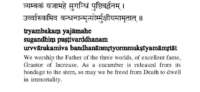
Mahamrtyunjaya Mantra [Prayer for Global Peace]
This is the text for the Mahamrytyunjaya Mantra provided in Sanskrit, with English translation. The Devi Mandir devotees chant this mantra for the health and well-being of all beings in the world.

Shivaratri Video: Q&A with Swamiji
Swami Satyananda Saraswati discusses why and how we worship on Shivaratri. He answers questions about the holy day’s pujas, the symbolism of Shiva’s madness following the death of Sati, and tells one of the many stories regarding the origin of Shivaratri.

Mahamrtyunjaya Mantra
The Mahamrtyunjaya Mantra is the mantra of the great victory over death. It is a prayer to Lord Shiva, and a powerful healing mantra. This disc has Shree Maa and devotees chanting this mantra.
The chanting on this CD is full of powerful healing vibrations. Excellent for healing on every level.
Maha Shiva Ratri, March 2011
~~OM~~ The Worship of Lord Shiva Early in the morning of Shivaratri, we saw our beloved Swamiji sitting in asan by the sacred fire and chanting many, many scriptures – […]
Celebrating our ancestors
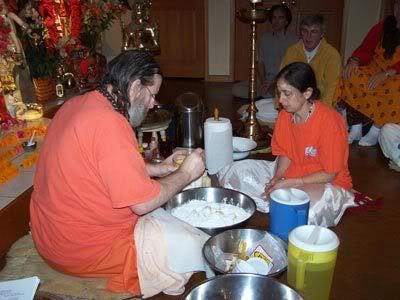
Photo of the week – Oct 12 – Oct 18 2007
(Picture taken October 10, 2007)
On October 10th we celebrated Mahalaya, the great Dissolution, and honored our ancestors thanking them for leading us here.
We performed puja with special ladhus that we offered at the altar, at the fire and then to nature.
Pranams to all the great souls that preceded us and brought us to the Devi Mandir!
Guidelines for Observing Navaratri
Question:
When is Navaratri celebrated ? Could you please let me know if there are six Navaratris and are they Varsha, Sharad, Shishir, Hemant, Vasant, Grishma?
Swamiji says:
Navaratri can be celebrated at any time. Most often it is observed from Pratipad to Navami or from Shashti to Purnima or Amavashya. There are four Navaratris which are special: Magh, Chaitra, Ashadh, and Ashvin. These correspond to winter, spring, summer, and fall.
Question:
Can you please suggest any guidelines for people wishing to observe the Navaratri fast in the same way that you do. (24 hours X 9 days. No water, no food)
Swamiji says:
Start off small and be content with small steps. Observe 24 hours with only water, then drink. Actually you will probably want salt more than water. Then try three days. And eat only fruits and water one time a day for the remainder of the nine days. Slowly you will extend it.
Question:
It is my understanding that no grains, or salty food is to be eaten during Navaratri. It is a symbolic giving up for the goddess. Are fruit and vegetables ok? To fast completely is for a greater tapas, and austerity. Is this correct?
Swamiji says:
The fasting gives forth a number of benefits. We suggest that everyone observe the vow according to their own capacity: the needs of the body, the activities in which the body must engage during the vow, etc. Some will give up grains and pulses, some will only take fruit and dairy, some will only take water: each according to his or her own capacity.
Question:
How do we count Navratri? Sundown to Sundown? Sunrise to Sunrise? Or Sunrise to Sundown?
Swamiji says:
We use a Panchanga, an almanac timed according to the phases of the moon.
Question:
Does one fast for 9 days during Navraatri without food, only water?
Swamiji says:
Some will fast on only water.
Question:
I would like to know is it possible to do homa of 108 names of Durga Ma from the Chandi Path for Navaratri?
Swamiji says:
Yes.
Navaratri at the Mandir
Question:
How do you observe Navaratri at the Mandir?
Swamiji says:
Mahalaya is the new moon before the Navaratri begins. We will perform the Cosmic Puja, complete Shraddha and Tarpana, and complete Chandi. The day after Mahalaya is the first day of Navaratri. Every day we will perform the Cosmic Puja, and complete Chandi. We will break the fast on the 8th night (ashtami).
Question:
What is the system that You and Shree Maa follow for prayers during Navratri?
Swamiji says:
We recite the entire Cosmic Puja and Chandi Path every day.
Question:
When during Navaratri do we worship Durga, when Lakshmi, and when Saraswati? What prayers are done during this period? Can Lalita Stotram also be recited?
Swamiji says:
We perform the entire Cosmic Puja every day. That includes Mahakali, Mahalakshmi, and Mahasarasvati.
Lalita can also be recited, but Chandi Path is not to be neglected.
Ambuvaci Festival
~~OM~~
Ambuvaci is a festival to honor and respect Divine Mother Earth during Her menstrual period. It is celebrated once a year at the temple of Kamakhya Devi. This year Ambuvaci is from June 22nd to June 25th.
There is never a time when the Divine Mother of the Universe is impure, so the idea that the Goddess hides during Her period is a misunderstanding. The period of menstruation is a time when women can become extremely still and silent, and get in touch with the ultimate consciousness of their feminine nature.
In ancient India a woman’s puja consisted of chopping wood, carrying water, preparing the prasad, cooking over a open flamed wood stove, in addition to making offerings at the altar. The Vedic Rishis suggested that women living in a joint family community, have no need for such strenuous activities during their monthly menstrual period, when their sensitive nature will allow them to go deeply inside. This time would be better spent in meditation.
There was no issue of impurity. There was a proscription against strenuous activity in preparing for worship during the time of menstruation. Allowing other family members to participate in the woman’s share of physical responsibilities, created a greater sense of understanding and appreciation for her contributions to the family.
Ambuvaci is the celebration of the Divine Mother’s retreat from the demands of Her devotees, who are constantly beseeching Her for intercession in their lives. For three days She resides in the solitude of Her feminine nature and enjoys the freedom from the concerns for Her children.
For three days we do not disturb the earth, we do not move fire, and the devotees make kirtan and mental worship. The sadhus sit outside Her temple and chant and sing and allow the Divine Mother the privacy of Her solitude.
At the end of the three days the temple is opened, and everyone enjoys darshan and blessings of the Divine Mother. In the Kamakhya Temple a famous piece of red cloth is offered as prasad. It is said to be cloth upon which Divine Mother sits during Her period, and it is highly cherished because it conveys powerful blessings.
Events and Festivals
Panchang 2011-2012: At Devi Mandir we follow the traditional sacred calendar called the Panchang, which gives the dates for the holy days and festivals through out the year. The Panchang […]
- « Previous Page
- 1
- …
- 3
- 4
- 5
- 6
- Next Page »