~~OM~~
This Week Last Week Archive Previous Page
- The seventh region is in the Sahasrara at the top of the head. If your contemplation goes there, then you go into Samadhi. All the knowers of the Supreme Divinity have the actual vision of divine communion with God.
– from Ramakrishna: The Nectar of Eternal Bliss
- People want realization and liberation, to become enlightened. Do not think it is something different from doing for others as you would have them do for you.
– from Gems of Wisdom
- Ramakrishna: Human beings are of four kinds: those who are bound to the world of desires and attachments, those who renounce the world, those who are liberated, and those rare souls who are eternally free.
– from Ramakrishna: The Nectar of Eternal Bliss
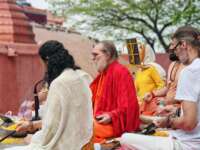
- Shree Maa performs worship at the sacred fire. Residing in the hearts of devotees, the flame of devotion is burning. In the agnya chakra, the light of meditation is shining. Yagya comes from the Sanskrit word to unite and the fire ceremony is the union of the fire within and the fire outside.
– from Shree Maa: The Life of a Saint
- Just as humans inhale oxygen and exhale carbon dioxide, and plants inhale carbon dioxide and produce oxygen into the atmosphere, in the same way, in the sacred fire ceremony, devotees surrender all negativities and receive the blessing of divine illumination.
– from Shree Maa: The Life of a Saint
- All thoughts of duality are sacrificed in the sacred fire and the joyous love of unity takes birth in the hearts of the participants. When Shree Maa sits for worship, the silence creates such stillness, that all observers are conducted to her vibration.
– from Shree Maa: The Life of a Saint
- Udas means a servant of circumstance. Whoever remains satisfied with whatever situation arises is established in wisdom.
– from Gems of Wisdom
- Ramakrishna: Men and women who are liberated are not infatuated with this world of objects and relationships. That is why, after becoming free, some just leave their bodies.
– from Ramakrishna: The Nectar of Eternal Bliss
- There is another characteristic of a bound soul. If you were to take that individual out of the world he is use to and put him into a holy environment, he would probably die of boredom.
– from Ramakrishna: The Nectar of Eternal Bliss
- Who has extreme renunciation? Those whose life force is totally dedicated to God with the sincere dedication a mother has for the child in her womb. He who has extreme dedication desires nothing other than God.
– from Ramakrishna: The Nectar of Eternal Bliss
- As you practice tapasya, your ego becomes less attached to thought. The thoughts are not becoming more pure. In reality you have the same thoughts, but you have less attachment to them.
– from Shree Maa: The Guru and the Goddess
- The asuras will teach us selfishness, the Gods will awaken consciousness. This conflict between selfishness and divinity is the perpetual cause of confusion, until we become one with the Light.
– from Shree Maa: The Guru and the Goddess
- Our ancestors provided us with all that we needed to progress in our search. And for that purpose we are beholden to seven generations previous to us, while seven generations to come will benefit from our attainment of understanding. Whether or not our ancestors knew what they were doing, they cultivated within us certain qualities which we needed in order to manifest our highest ideal of perfection.
– from Shree Maa: The Guru and the Goddess
- True wisdom makes a man humble.
– from Gems of Wisdom
- If you don’t have the physical presence of a person who inspires you, read a scripture. Sit by a symbol of divinity and listen to the wisdom of the wise.
– from Before Becoming This
- The feeling of devotion is what fosters our spiritual development; such things as reading books are not enough. When we do puja or other forms of worship, it’s best to sing loudly and enthusiastically so the Gods will hear us! Furthermore, our worship is even more meaningful when we feel gratitude that we have the impulse and the opportunity to perform these devotions.
– from Shree Maa: The Life of a Saint
- Mother’s love helps you realize that is not the words that are important but the actions.
– from Shree Maa: The Life of a Saint
- Keep your life simple, always be truthful, and give pure love to all, recognizing all as God.
– from Shree Maa: The Life of a Saint
- The influence of maya is so strong, always pulling you out. Tapasya, purifying austerities, are very necessary.
– from Shree Maa: The Life of a Saint
- When I think of Maa, I think of Truth. She is what Truth is, powerful and absolute, but Maa is also gentle and kind. I was a stranger and she took me in. I was hungry and she fed me.
– Shree Maa: The Life of a Saint
- Our responses should be calculated to take us to a better place than we are already at and help us to accomplish our objectives. If we could stop and put one instant of discrimination between the stimulus and the response, then we could live life perfectly.
– from Gems of Wisdom
- A realized being sees that the God within you is the God within me. If I lift you up in any way, I am doing good to myself an I am doing good to my world. It benefits me to do good to others. It is all me.
– from Before Becoming This
- The power that comes from the feeling that we are being blessed allows us to move forward with renewed vigor. We have more strength and courage. We have a different attitude that makes things work better. Every time we take the name of God, We get a blessing.
– from Before Becoming This
- The pujas allow us to expand our consciousness to that awareness (of divinity) and cultivate that relationship. We begin by seeing God in little things. We practice seeing God in a flower, in a candle, in an altar of worship, in a form of deity that we put our love and devotion into. Then the relationship increases exponentially.
– from Before Becoming This
- Each one of the deities is an embodiment of a whole set of spiritual and philosophical aspirations. They are an embodiment of an entire school of philosophy and a whole set of spiritual practices which are designed to bring us to the realization of that philosophy. So the various arms, weapons and mudras (gestures) are all indicative of aspects of spiritual disciplines.
– from Before Becoming This
- There are many levels of meaning to dharma. Some people speak of dharma as a religion: Hindu, Muslim, Christian, Buddhist or Jewish. Other people speak of dharma as the universal laws of nature. Everything in between is included in the definition. On every level of the evolution of consciousness you will find an expanded definition until you are one with God, and then you will know the real meaning of dharma.
– from Before Becoming This
- Ramakrishna: It is very difficult to take on the responsibilities of a teacher. Without being given the authority from God, it is very difficult to teach. If you begin to give instruction without authority from God, people will not listen to you. Such teachings have no power. First you do sadhana. In some way you have to attain to God. When you get the authority from God, then you may lecture.
– from Ramakrishna: The Nectar of Eternal Bliss
- Always maintain the highest ideal of behavior, and surrender your life unto the ideal.
– from Gems of Wisdom
- Physical enjoyment in the world is like the strike of a cobra. Learn to keep the cobra far away or under control. The comfort of the senses is and illusion, which bears no sustaining reality. In the senses there is no comfort. Only there exists the reflection of Nature.
– from Gems of Wisdom
- Perform all actions with Love and respect for Truth, and maintain the great power of the non-attachment of asceticism.
– from Gems of Wisdom
- Love and Trust in God. Do not ask for anything else.
– from Gems of Wisdom
- Always and with all your might, recite and study books of Dharma.
– from Gems of Wisdom
- Have no fear of anything is this world. The world is the examination grounds for detachment form pleasure and pain. Do not give disruption an opportunity to dwell in your mind. God dwells in your heart. With the greatest faith, always remember God.
– from Gems of Wisdom
- Always keep your mind in an attitude of purity. Then peace will come. Do not allow your inner attitude to be deflected by the pains and difficulties of the external world. This is known as Peace. When your inside and outside exhibit peace, then you have found the fruits of sadhana.
– from Gems of Wisdom
- If you only desire the fruit of your actions then you won’t enjoy the fruit or the process. This is a lose, lose proposition. But if you enjoy the process you can’t lose. Then your work becomes worship. We are praying for the joy of prayer. Try to take that attitude into your actions and make this world a better place.
– from Gems of Wisdom
- If you have your own goal and a plan you will certainly enjoy life more because it is your plan and does not belong to anybody else.
– from Gems of Wisdom
-
Question: What does a person do who doesn’t have a purpose?
Swamiji: I suggest that a person without a purpose better find one. Without a purpose it is difficult to have a meaningful life. How can you accomplish anything if you don’t know what your purpose is? We need to find a goal that would be worthy of our commitment.
– from Before Becoming This
- The best thing to do is to stop and think, “What would be a commitment worthy of my dedication. What do I want to give to this world?”
– from Before Becoming This
- Shree Maa: Ultimately we have to change, and that is God’s blessing.
– from Before Becoming This
- When you love so much that you don’t think about the distractions and you think only about your beloved, then you really are a lover.
– from Before Becoming This
- Satsangha is a bonding process, so that people within the congregation try to network their skills and talents and opportunities.
– from Before Becoming This
- We are not seeking communion only at the time of puja or worship, but in every breath, in every activity. It does not matter whether we are digging a ditch, teaching in school, appearing in court, negotiating a contract or performing a homa (fire ceremony). Our attitude with which we perform these functions is the most important aspect of worship.
– from Gems of Wisdom
- By means of her compassion, we become liberated. She is the one who binds all to worldliness, and She is the one who liberates.
– from Ramakrishna: The Nectar of Eternal Bliss
-
Maa says to us. “Ok, kids go out and play in this world.” What is the fault of the mind? If she is compassionate to us, then She’ll bring our minds back to Her. Then we find liberation from all these worldly thoughts, and we keep our minds at the Lotus Feet of the Divine.
– from Ramakrishna: The Nectar of Eternal Bliss
- After you have attained the perfection of discrimination and renunciation, only then should you enter the world. In the ocean of worldliness, there are many crocodiles with names like desire, attachments, and anger. If you rub turmeric on your body and submerge yourself in the waters, you have no fear of crocodiles. If you rub the turmeric of discrimination and renunciation over your body, you can submerge yourself in the ocean of worldliness without any fear at all. God is Truth. That is the eternal phenomenon. Everything else is transient. It is impermanent.
– from Ramakrishna: The Nectar of Eternal Bliss
-
In the Sundar Kanda of the Ramayan, Tulasidas wrote a beautiful verse:
“Dear one, take all the pleasure between heaven and earth and count them as one. As great a delight as that might be, it can’t possibly be as enjoyable as satsanga.”
– from Shree Maa: The Guru and the Goddess
- Through satsanga we have the opportunity to improve ourselves, to really make significant changes in our lives, to become the individual we respect. No other pleasure could be equal to becoming the person we love. That s why satsanga is so important.
– from Shree Maa: The Guru and the Goddess
- Extract the nectar from the tapasya that you are performing. Tapas literally means heat, but implies any act of purification in which our negative tendencies are burned away
– from Shree Maa: The Guru and the Goddess
- Swamiji: Look for those mantras that say, “I belong to you, I am the echo of the vibration that is your soul.” As you practice those particular sections, other parts will call you as well. If you don’t pronounce the mantras correctly, don’t worry. Put yourself in the attitude of surrender to the will of God and try to come as close as possible.
– from Siva Puja and Advanced Yajna
- “Always study words of wisdom, with all your capacity act in accordance and perform the discipline of these words, and following the systems of worship they enumerate, make the worship of the Supreme Lord, and don’t allow your consciousness to contemplate adverse desires.” – Shankar Acharya, 700 A.D.
– from Siva Puja and Advanced Yajna
- “Wipe all the dross of sin from your mind, search for the faults in the pleasures of the world, search your own soul for true knowledge, and very quickly try to renounce the attachments to your home.” – Shankar Acharya, 700 A.D.
– from Siva Puja and Advanced Yajna
- “Maintain the association of true people, take refuge with devotion in the Supreme Divinity, and with all your capacity try to befriend the universe, and very quickly renounce the fruits of your labors.” – Shankar Acharya, 700 A.D.
– from Siva Puja and Advanced Yajna
- “Whenever possible seek out the company of the true and knowledgeable people, and serve the sandals of their lotus feet, and ask from them even one letter of the knowledge of the Bhraman, and listen to the great words of wisdom from the Vedas.” – Shankar Acharya, 700 A.D.
– from Siva Puja and Advanced Yajna
- “Take the cure for the illness of uncontrolled desire, and serve your doctor as a beggar would serve a Lord, don’t seek the association of pleasure-seekers or self-centered individuals.” – Shankar Acharya, 700 A.D.
– from Siva Puja and Advanced Yajna
- “Remain contented with whatever you receive in a divine union, that which God has consented to give.” – Shankar Acharya, 700 A.D.
– from Siva Puja and Advanced Yajna
November 4 – November 10
November 11 – November 17
November 18 – November 24
November 25 – December 1
December 2 – December 8
December 9 – December 15
December 16 – December 22
December 23 – December 29
This Week Last Week Archive Previous Page